Hermitages of Abruzzo - Santo Spirito a Majella
Menu Section
Eremi of Abruzzo • San Giovanni • San Bartolomeo • Santo Spirito • S.Onofrio al Morrone • S.Onofrio di Serra
Monastery built into the rock (Roccamorice – Pe, 1132m)
Information and visits: contact the Roccamorice Town Hall. Visits have to be booked.
How to get there: Leave the A25 pescara-Rome motorway at Scafa and follow directions to Roccamorice. On arriving in the village follow signs for the “Eremo di S. Spirito a Majella” and after 10 km you reach the monastery. In winter the road may be closed because of snow.
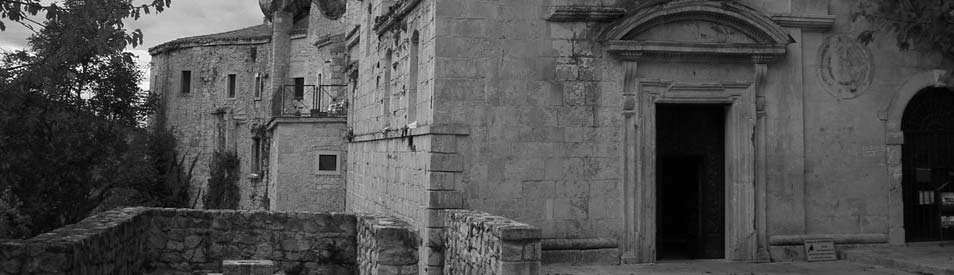
Santo Spirito a Maiella is undoubtedly one of the most famous and biggest monasteries on the Maiella Mountain as well as the richest in history and traditions. Despite the many changes it has undergone in the last one thousand years, it has not lost its appeal thanks to its splendid position in the valley to whLike all the hermitages on the Maiella Mountain, we do not know when it was first built, but we presume it was prior to the year 1000. Its first distinguished guest was Desiderio, the future Pope Victor III, who stayed there in 1053 with some hermits and built a small church. In the following century it was probably abandoned given the conditions in which Pietro da Morrone found it in the middle of the thirteenth century. From 1310 to 1317 Beato Roberto da Salle was prior of the hermitage and in 1347 Cola di Rienzo lived there for a few months.
The following two centuries were a period of gradual decline, and only when the monk Pietro da Manfredonia arrived in 1586 did the monastery begin to flourish again. In a few years he succeeded in restoring the hermitage, adding, among other things, the “Santa Scala” which leads to the “Oratorio della Maddalena”. Then there were good and bad periods until 1807 when some monastic communities were suppressed. The hermitage was abandoned once again; during the nineteenth century there were numerous attempts to restore it to its old splendour but with very limited results. The lower part of the great monastic complex consists of three well-defined sectors. The first sector includes the church, the sacristy and living quarters distributed on two floors. Then there are the remains of six large rooms that were the services of the old convent. The first two sectors are on a rocky wall and create a long corridor that leads to the “Guests’ rooms or Prince’s House”, recently restored. From the Guests’ rooms two long ramps of a staircase called the “Scala Santa” lead to the “Oratorio della Maddalena” and to two large balconies built in the rocks. In the square the remains of some great drinking troughs built into the rock can be admired. Beneath the church, on the valley side, there is the entrance to the original hermitage which was entirely carved in the rock, and around which the monastery grew up. There are many legends about this place of worship, and in particular about Pietro da Morrone. Stories of Devils, sacrileges and exemplary punishments all focused on the figure of the pious hermit. In the past, many parties of pilgrims arrived at the Abbey going up the Valley or crossing the mountain; today only at the opening of the "Perdonanza" on August 29, can we notice a discrete participation of devotees.
Text and photo by Edoardo Micati