Hermitages of Abruzzo - San Bartolomeo di Legio
Menu Section
Eremi of Abruzzoo • San Giovanni • San Bartolomeo • Santo Spirito • S.Onofrio al Morrone • S.Onofrio di Serra
Celestinian hermitage built into the rock (Roccamorice (Pe) 650m)
Information and visit: for information ask at the Roccamorice Town hall. The hermitage is always open. How to get there: Leave the A25 Pescara-Rome motorway at Scafa and follow directions to Roccamorice. Go through the village and turn right when you reach the turning for Santo Spirito and go along the road which after a few houses bears left. Go past some fields and turn left when you get to an iron cross and head for the edge of the valley. Go along a steep path for one hundred metres until you reach another iron cross on the path coming from the village of Pagliara. Follow the path up the valley intil you reach the hermitage (30 minutes).
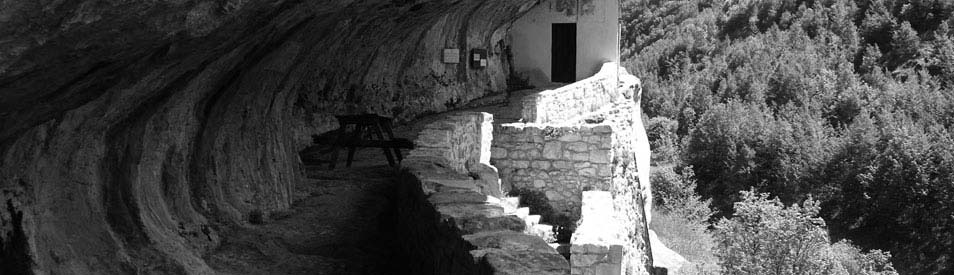
The hermitage was rebuilt in the thirteenth century by Pietro da Morrone. We do not know exactly when the hermitage was first built but we presume that, like Santo Spirito situated nearby, it is before the year 1000. What we know for sure is that the future Celestino V went there with a few followers around 1274 and remained there more or less permanently until 1276. As a consequence of its nearness to villages and frequent visits from pilgrims, Celestino preferred to move to San Giovanni d’Orfento in later years. Situated at a height of 600 metres above sea level in the Santo Spirito valley, the hermitage extends under an enormous roof of rock through which a hole has been made in the first part to enable people to descend to the terrace below. This balcony of rock is closed on the opposite side by the wall of the church that has some frescoes above the entrance. These frescoes, which unfortunately have been damaged by time and ignorance, date back to the reconstruction by Pietro da Morrone. The small building gets its light from a window-door; opposite the door, under a square stone, water gushes out of the rock and is collected in a tank dug out of the floor. A small door at the side of the altar leads to two small rooms that were the hermit’s living quarters. Here the balcony ends and a long staircase leads back to the valley.
In the middle of the balcony there are two other staircases; the one on the right, the “holy staircase” was only used to go up to the hermitage by pilgrims who usually climbed the steps on their knees in prayer. In the valley below there is a natural bridge and a spring which are both linked to local traditions and legends. The hermitage is still a popular destination today for pilgrims, above all during the August 25 procession. A multitude of pilgrims make their way to the hermitage in the morning and after mass carry the saint to the village in a procession. The participants walk along paths that have been used for centuries, taking it in turns to carry the statue in their arms, one at a time, as if it were a child. The beautiful wooden statue of the saint has a skin over the left shoulder and a knife in the right hand. According to tradition these icons refer to when Saint Bartholomew was skinned alive in the East and became a martyr.
The believers take holy water from the spring under the rock inside the church and give it to relatives or send it to members of the family who have emigrated abroad. The holy water is used in many ways: it is the last hope for the dying and is considered miraculous for children’s illnesses and the treatment of sores and wounds. In ancient times it was also considered the only remedy for “pernospera”, a fungus which attacks vines.
Text and photo by Edoardo Micati