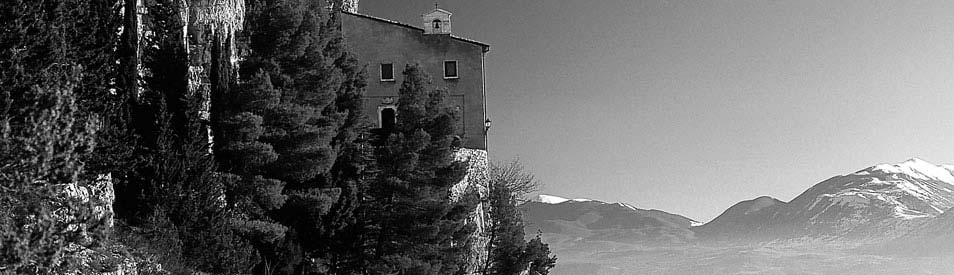
Hermitages of Abruzzo - Sant'Onofrio al Morrone
Menu Section
Eremi of Abruzzo • San Giovanni • San Bartolomeo • Santo Spirito • S.Onofrio al Morrone • S.Onofrio di Serra
Monastery built into the rock (Sulmona - Aq, 630 m)
Information and visits: for visits inside the church, contact the priest of the parish “Sacra Famiglia di Badia”. Tel. 0864 251325
How to get there: leave the motorway (25 Pescara-Rome) at Pratola Peligna and follow directions to the village of Badia, where from the square, a path leads to the sanctuary of Ercole Curino and to the hermitage of St. Onuphrius. The path is very easy to see and climbs towards the Hermitage following some wide bends (30 minutes).
The hermitage of St. Onuphrius was the last one built by Pietro, after 1290; he settled in this place in 1293, returning from the solitude of Orfento. He spent just over a year there, until the day five legates from the conclave went up to announce his election as Pope. Very probably the holy man had visited the area even earlier, taking shelter in a cave beneath the hermitage. He may have stayed in the same cave while the cells were being built above it. After he renounced the papacy, Pietro went back to his hermitage with the illusion that he could end his days there, but after only two months he was forced to leave again and this time permanently.
With the abolition in 1807 of some religious orders, after a period of abandonment that is common to many monasteries, the hermitage saw a long series of hermits, laymen and religious, who cared for the holy place. Some of them, especially the laymen, were interesting and eccentric people, surrounded by an aura of mystery that often follows those who choose this kind of life. The complex suffered serious damage in the last war and the reconstruction partly changed its external appearance. The most interesting and evocative part is undoubtedly the most ancient, the oratory and the two subsequent small cells, where Fra’ Pietro and the Blessed Roberto da Salle stayed. Much has been written about the cave beneath the hermitage, since many traditions are linked to it. Pansa reports that from works by some authors on the life of the Saint you can deduce that the ritual of "incubatio" was once practised in the cave.
You can still observe traces of the ancient rite of rubbing one’s body on the walls of the cave and it is clear that there was a cult of water: the faithful wet themselves in water dripping from the roof of the cave and bring the water back home because they believe it has therapeutic properties. In Sant’ Onofrio the pilgrims pick up rosemary from the garden and break off branches from the trees that are along the road leading to the sanctuary. They also take away rocks, dust and debris from the sanctuary to save as relics of the place. Another custom full of symbolism is the throwing of a stone from the terrace. The idea is that the stone absorbs our physical diseases, ills and pains. Throwing the stone forcefully into the air means getting rid of the evil we have inside and keeping it as far away as possible. Pilgrims visit the hermitage especially on Jun12, which is Sant’Onofrio’s day. In the past many flocked to the hermitage on May 19th, the recurrence of Celestino V’s death.
Text and photo by Edoardo Micati